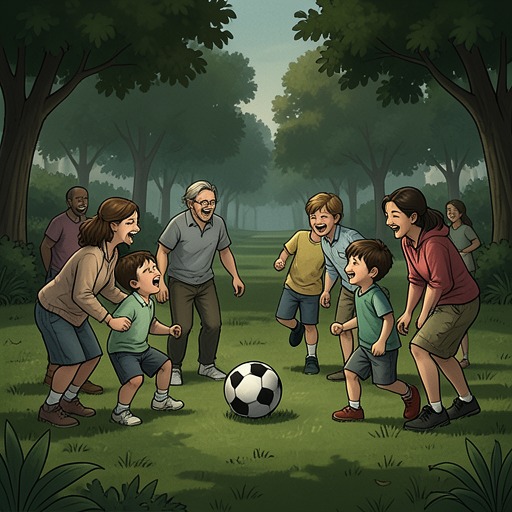
Hostile rivalry between the Yaxiao Team and the Invincible Team
Kevin the Star StrikerThe Wild Bunch–Unbeatables rivalry begins as a coercive seizure of the soccer field and develops into a contest over belonging, courage, and the meaning of being a team. The Unbeatables possess the field through age, physical intimidation, and daily practice; the Wild Bunch answer by accepting a two-week challenge, turning a humiliating expulsion into a match governed by agreed conditions. The rivalry reaches its decisive form in a ten-goal battle, where cooperation, fear, discipline, and trust overcome the Unbeatables’ apparent superiority.
Origins: Exclusion and Possession
The conflict is not initially a sporting rivalry at all. Mickey the Bulldozer arrives with the group that follows him and announces that the soccer field belongs to the Unbeatables alone. His declaration excludes the Wild Bunch from the place where they play, practice, and understand themselves as a group. The field therefore becomes more than a patch of ground: control of it determines who has the right to gather, compete, and call the neighborhood’s soccer life their own.
The difference between the teams appears overwhelming. The Wild Bunch have not played together for months because winter remains in their bodies, and they no longer have access to the field for practice. The Unbeatables, by contrast, can train every day. They are also four or five years older, physically larger, and surrounded by reputations that make the younger players fear them. The disparity is both athletic and social: the Unbeatables possess time, space, experience, and the authority to enforce their claim by presence alone.
Mickey’s power depends on spectacle and threat. The ball is kicked into the fence with enough force to splinter a plank, demonstrating that the Unbeatables can turn an ordinary soccer object into a weapon. Yet the Wild Bunch do not simply retreat. Kevin catches Mickey’s next throw and sends the ball back, then gives the Unbeatables two weeks before challenging them in soccer. The proposed stakes are absolute: if the Unbeatables win, the field remains theirs; if the Wild Bunch win, the older boys must leave and the field belongs to the younger team forever. Kevin thus replaces uncontrolled intimidation with a public rule whose outcome both sides must accept.
From Fear to a Shared Contest
The challenge initially seems reckless because the Wild Bunch lack the field, preparation, and confidence required to defeat the Unbeatables. Their fear is visible in their silence, lowered heads, and uncertainty about how victory could be possible. Larry’s intervention changes the rivalry’s terms again. Rather than promising that the opponents are weak, he asks whether the players truly want to beat them and insists that a coach can work only through complete mutual trust.
Larry’s most important revaluation is of fear itself. When Diego asks what the team should do about being afraid, Larry answers that fear gives them a chance and calls it their strength. This claim opposes Mickey’s model of toughness, which presents fearlessness, aggression, and physical dominance as proof of superiority. The Wild Bunch do not become powerful by pretending that the Unbeatables are harmless. They become capable of playing by acknowledging danger while learning to act together despite it.
Training turns that principle into physical practice. During the passing exercise, the ball moves through the players in sequence while Larry corrects movement and positioning, telling Kyle to approach the ball instead of waiting for it. The team reaches ten passes and continues to seventeen before Sox finally gives up, panting and covering his eyes with his paws. Larry withdraws to watch, visibly thrilled by the team’s play, and the players embrace one another before forming their first circle. Their shared cry, “ONE, TWO, THREE WILD!”, converts separate players into a collective identity that can face the Unbeatables as a unit.
Rules, Stakes, and the Final Match
The rivalry becomes most legitimate when the teams negotiate an additional condition: the losing team must repair Larry’s stand. This rule expands the consequences beyond possession of the soccer field. The match will determine not only which team plays there, but also who accepts responsibility for the damage and disorder surrounding the conflict. The challenge therefore contains a rudimentary form of restoration: defeat carries an obligation to repair rather than merely an obligation to withdraw.
The match begins with the Wild Bunch displaying coordinated movement. Kevin kicks off and passes to Alex Alexander, who returns the ball to Tyler; Tyler sends a precise pass toward Danny, and the ball travels through Joey and the other players before Kevin shoots. The Unbeatables are briefly immobilized by the speed of the combination, but Octopus catches the shot. The older team then responds with the force that has defined its reputation. Kong leaves Julian Fort Knox behind, Mickey shoots immediately, and although Kyle reaches the correct corner, the ball rebounds into the goal.
The score quickly favors the Unbeatables. Their attacks exploit the Wild Bunch’s fear and physical disadvantage, while Octopus’s goalkeeping makes every opening seem to close. Nevertheless, the younger team begins to answer through passing rather than isolated heroics. Kevin’s heel pass releases Alex Alexander for a powerful shot that carries Octopus into the goal, and Julian Fort Knox, previously overwhelmed by Kong, starts confronting him directly. Julian’s repeated defensive positioning makes him seem to be everywhere, marking the moment when he recovers his role as the team’s all-in-one defender.
Rain changes the match’s physical conditions and exposes the value of the Wild Bunch’s preparation. The ground becomes soft and muddy, causing the Unbeatables to slide, while the Wild Bunch have trained on comparable ground for twelve days. Kevin scores his third goal, Danny scores his second, Joey brings the score level at seven to seven, and Tyler contributes a long-range shot carried into the goal by a gust of wind. Diego then forgets his asthma and becomes the Tornado again, helping the Wild Bunch reach nine goals. The comeback is therefore produced by several forms of contribution: individual finishing, midfield control, defensive recovery, adaptation to mud, and renewed confidence.
The Decisive Turn: Passing Instead of Possession
At nine to seven, Kevin’s desire to score the tenth goal threatens the cooperation that made the comeback possible. He keeps the ball instead of passing, and Larry removes him from the field, replacing him with Roger. Kevin protests because he fears that the substitution will cost the team the victory, but Larry’s decision makes the rivalry a test of discipline as well as skill. The player who began the challenge as the loudest individual challenger must learn that personal glory can endanger the group.
The decision is immediately tested. Mickey scores the Unbeatables’ eighth goal, and Roger misses a chance to win. The Grim Reaper then equalizes the match at nine to nine, making the next goal decisive. Kyle prevents defeat with two desperate saves, including a nosedive that takes the ball from the lower-left corner and a second recovery that steers Kong’s follow-up around the post. The match’s suspense comes from repeated reversals: dominance becomes vulnerability, a missed chance becomes a possible defeat, and the goalkeeper’s physical exertion keeps the game alive.
Kevin finally promises to pass, but the decisive proof comes when Roger receives another opportunity and ignores Kevin’s instruction to use his left foot. Roger strikes the ball into the net. The Wild Bunch win, and the goal reverses Roger’s position within the rivalry and within his own team. He is no longer merely the player whose error might cost them the match; Kevin calls him Roger the Hero, and the team carries him across the field. Victory belongs to the player who had been doubted, but it also belongs to the passing structure that allowed the chance to exist.
Aftermath and Meaning
The victory restores more than the field. Kevin and Roger embrace, and Larry specifically praises Kevin not only as a dribbler and star striker but also for producing the stubborn assist that made the winning goal possible. Kevin and Roger then acknowledge one another’s contributions: Roger’s goal required Kevin’s pass, and Kevin’s pass required Roger’s refusal to surrender. Their repaired friendship shows that the rivalry’s deepest resolution is relational as well as competitive.
The Unbeatables retreat over the wooden fence after Sox drives them away, and Mickey warns that the Wild Bunch will pay for the defeat. His threat preserves the antagonism’s energy, but it no longer controls the field. The older boys disappear as suddenly as they arrived, while the Wild Bunch remain together under a clearing sky, with Sox wagging his tail and the former conflict between Kevin and Roger replaced by companionship. The field has been recovered through a contest, yet the ending refuses to define victory as simple domination: the decisive transformation is from exclusion to recognized play, from fear to coordinated action, and from solitary pride to mutual trust.